
RECO's advertising guidelines apply to social media in full. A Reel, TikTok or Short that promotes an Ontario agent, a listing or a service is an advertisement, so it has to name the brokerage as registered, name the agent as registered with a permitted term, and stay away from anyone's property, face or price without their consent. We read RECO's four advertising bulletins on November 21, 2026 and checked 30 viral real estate videos against them.

Do RECO's advertising guidelines apply to Reels and TikTok?
Yes. RECO Bulletin 5.1 defines advertising as any notice, announcement or representation directed at the public, made by or for a brokerage or agent, that is intended to promote them or their business, services or trades, in any medium. It lists social media sites by name. Bulletin 5.3 says it plainly: social platforms may seem less formal, but the same advertising requirements apply.
So a 20-second listing Reel is held to the same standard as a newspaper ad or a For Sale sign. The four things RECO asks for are short:
- Tell the public who you are: the brokerage and the agent, by their registered names.
- Keep every statement current, accurate and verifiable.
- Get consent before you show a property, a person or the terms of a deal.
- Nothing false, misleading or deceptive.
This post is a marketing checklist built from RECO's own pages, read on November 21, 2026. It is not legal advice. RECO says its bulletins are for convenience and the legislation, the Trust in Real Estate Services Act, 2002, has the complete details. Your brokerage's advertising policy comes first, because Bulletin 5.3 makes the brokerage responsible for every agent's social media.
What has to be on every video?
The brokerage name, clearly and prominently, exactly as it is registered with RECO. Bulletin 5.1 says agents are prohibited from advertising in any manner unless the brokerage is clearly and prominently identified, and it applies to teams the same way.
When the video refers to an agent, the agent's name has to be the name registered with RECO. Short forms and nicknames must not be used. The name goes with a permitted term from Bulletin 5.2:
| Who | Terms RECO permits |
|---|---|
| Salesperson | salesperson, real estate salesperson, sales representative, real estate agent, real estate sales representative, REALTOR® or REALTOR® salesperson (CREA members in good standing only) |
| Broker | broker, real estate agent, broker real estate agent, real estate broker, REALTOR® or REALTOR® broker (CREA members in good standing only) |
| Broker of record | "broker of record" |
| Team | No separate term. Each salesperson, each broker and the brokerage are identified the same way |
| Personal real estate corporation | Cannot advertise at all |
Is the bio enough? Our reading is no. Bulletin 5.3 asks for two things. The account profile must show the agent's and brokerage's proper identification through its fields and images. And each message relating to trading in real estate must comply too, on personal accounts as much as business ones. A Reel gets shared, stitched and reposted without your bio attached, so the safe build is the brokerage name on screen in the video and again in the caption.
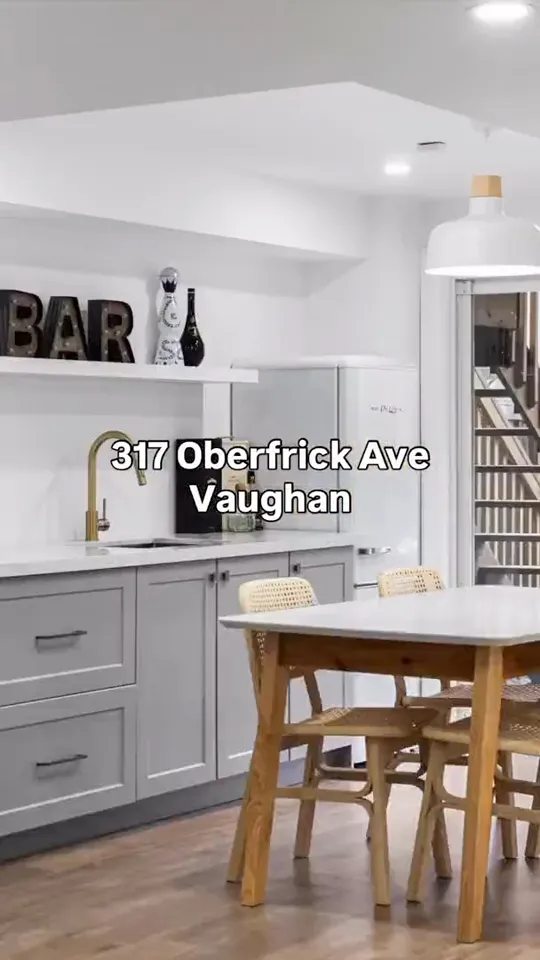
Here is what that looks like on a real listing video. These three frames are from the Vaughan listing Reel we filmed with Kash Alavi, which passed 240K views.

Which consents does a real estate video need?
Three, and they belong to three different people. Bulletin 5.1 says an advertisement must not include anything, image or text, that could reasonably be used to identify:
- a specific property, unless the owner consents;
- a party to a transaction, unless that party consents;
- the contents of an agreement, such as the price, unless all the parties to the agreement consent.
To see how often that matters, we took the 30 real estate videos in our September 2026 outlier report: 15 Instagram Reels and 15 TikToks that each beat their own account's usual views, 22 of them past one million views. Most were filmed outside Ontario, so RECO does not govern them. We used them as ideas an Ontario agent might copy, and asked what each idea would need before posting.
Twenty-four of the 30 show a specific home. For your own listing that consent comes from the seller, and it belongs in writing with dates. The risk sits in the other cases: a video of a home you do not have listed, a clip that stays up after the listing ends, or a buyer who never agreed to be in your marketing.
Does a price on screen help or hurt?
It helps the video, and the rule on it is manageable. The six videos that put a price or a monthly payment on screen ran a median of 133.3 times their account's normal views. The 18 property videos with no number ran 50.3 times.
For an active listing, our reading is that the asking price is covered by the seller's consent to advertise the home, and Bulletin 5.3 asks that everything said online be current and accurate. A price change means a caption edit or a re-upload the same day. A monthly payment on screen is a calculation, so show how it was calculated: Bulletin 5.1 says a statement that is true but vague or incomplete, where clarity is necessary, counts as inaccurate.
A sold price is a different thing. It is part of an agreement, and it needs both sides.
Can you post a "just sold" Reel?
Yes, with the right signatures. Bulletin 5.4 sets out whose written consent is needed, and it changes on closing day:
| What the video says | Before the deal completes | After the deal completes |
|---|---|---|
| "Sold", with or without the home in frame | Seller's consent | Buyer's consent |
| "Sold" with the price or other terms | Seller's and buyer's consent | Seller's and buyer's consent |
The rule is the same whether the seller's brokerage or the buyer's brokerage posts it. The consent must be clear, and it must carry the date it takes effect and the date it expires. If the other side had their own agent, the request goes through that agent.
Now look at the bottom of the chart. The two closing-day videos in the set, a key-passing transition and a celebration edit, ran 4.0x and 4.8x, the weakest results of the 30. Two videos is a lead, not a law.
But it matches what we found for law firm videos, where the courthouse win was both the most regulated format and one of the weakest. A format that needs two signatures and still underperforms is a poor use of a shoot day. Strangers do not care that you closed. They care about the house, the price and the mistake they might be about to make.
Can you film a home that is not your listing?
Only with permission, and the bulletin is specific. Bulletin 5.3 describes agents sharing footage of home showings, even when the listing belongs to another agent, to make content. Permission from the seller or tenant is required, through the agent who represents them. If consent is given, the post must credit the originating brokerage and include its name and contact information.
One video in the set was exactly this kind of idea: a house hunting series, house 4 of 5. It ran 6.3x. The first-home tour with the buyers on camera did far better at 309.7x, and it needs a different consent: Bulletin 5.3 says showing photos and names of happy buyers requires their written consent, and so does tagging someone.
What is the easiest kind of video to get right?
One with no property and no client in it. Four of the 30 fit: advice on what to do before lowering a price (494.0x), realtor code words decoded (48.8x), the worst upgrades for resale (13.2x) and a skit about being house poor (16.1x). Their median was 32.5x, below the set's 58.2x, but the top one beat every property video except two.
These need the name rules and accurate statements, and nothing else. No consent form, no expiry date. That matters more than it sounds, because of one line in Bulletin 5.3: photos and video content cannot remain online past the end date identified in the written consent, and agents must review their accounts and remove what they no longer have permission to use. A listing Reel has a shelf life. An advice video does not.
If the advice video makes a claim about you, the claim rules apply. "Top agent", sales volume and awards all need their basis shown: how the volume was measured, the source and date of the award, and for a team award, that it is a team award and the size of the team. Where a caption has no room, Bulletin 5.3 allows an easy to find link to the full explanation.
A pre-post checklist for a listing Reel
- Brokerage name on screen and in the caption, exactly as registered with RECO.
- Agent's registered name with a permitted term. No nickname.
- Profile shows the same identification, and is updated the day you change brokerages.
- Owner's consent to show the property, with a start date and an end date. Put the end date in your calendar as the takedown date.
- Written consent from every person on camera who is a party to a deal, and from anyone you tag.
- Price current today. Payment figures show how they were calculated.
- "Sold": seller's consent before completion, buyer's after. With the price: both.
- Another agent's listing: permission through that agent, and their brokerage's name and contact information in the post.
- Any ranking, volume or award claim has its basis in the caption or one link away.
- Your brokerage has seen it, if its policy asks for that.
Then judge the video against your own account's usual views with the outlier calculator, not against someone else's view count. Our work for agents and brokerages includes RECO-compliant editing, in English and in Farsi. It is laid out on our page for realtors in Toronto, and the wider playbook is in our guide to real estate video marketing in Toronto.
If you are hiring a social media marketing agency in Toronto for a brokerage, ask to see their version of this checklist, and read what the contract should say about who takes a video down when a consent ends.
Frequently asked questions
Is the brokerage name in my Instagram bio enough for RECO?
By our reading of Bulletin 5.3, no. The profile must show proper identification, and each message relating to trading in real estate must comply as well. Put the brokerage's registered name in the video and in the caption so it travels with the post when it is shared.
Can I use my nickname or my team name on a Reel?
Not in place of the registered names. Bulletin 5.1 says the agent's name must be the one registered with RECO and that short forms and nicknames must not be used. A team advertises under the same rules as a single agent, with the employing brokerage clearly and prominently identified.
Can I post a sold price on Instagram?
Only with written consent from both the seller and the buyer, before or after the deal completes. Saying "sold" without the price needs the seller's consent before completion and the buyer's consent after it. Each consent needs an effective date and an expiry date.
How long can a listing video stay online?
Until the end date in the written consent. Bulletin 5.3 says photo and video content cannot remain online past that date, and that agents must review their accounts and remove content they no longer have permission to use. If you want the video to stay up as portfolio work, ask for that in the consent.
Do the rules apply to my personal account?
Yes, when the post relates to trading in real estate. Bulletin 5.3 says agents who use one account for both personal and professional purposes, or who advertise on both personal and business accounts, must make sure both accounts and each such message comply.
What if a buyer asks me to take a video down later?
Take it down. Bulletin 5.3 says that even where consent was obtained, a buyer or seller might later ask for information to be removed, and that promptly removing it demonstrates integrity and professionalism.