
A Toronto business should usually start with organic social media and pay only to push the videos that already worked. Paid buys reach on demand, but it cannot tell you what to say. Organic does, for free, every week. Below: what Toronto agencies actually sell, what one client month of organic reach looked like in Instagram's own numbers, and the boost rules that decide whether a video can be paid for at all.
Organic or paid: which should a Toronto business do first?
Organic, in most cases. Post short videos for free until a few of them clearly beat your account's usual views, then pay to show those winners to more people. Paying first means paying to find out which message works, and organic answers that question at no media cost.
There are exceptions. A business with a launch date, a sale that ends Sunday or a job posting that has to be filled this month needs reach on a schedule, and organic never comes on a schedule. Paid also lets you pick who sees a post by age, place and interest, which matters if your buyer is a narrow group: say, homeowners in Leaside, or dentists across Ontario.
For everyone else, paid is a multiplier. It multiplies whatever you give it, including a weak video.
What is the difference between organic and paid social media?
Organic is everything you post without paying the platform: Reels, TikToks, Shorts, carousels, Stories. Who sees it is decided by the platform, which on Reels and TikTok mostly means people who do not follow you yet, shown the video because people like them watched it to the end.
Paid is anything you pay the platform to show: a boosted post, or an ad built in Meta Ads Manager or TikTok Ads Manager. You choose the audience, the budget and the dates, and you keep paying for as long as you want the reach.
The practical difference is ownership. A video that grows on its own keeps getting views after you stop working on it. A paid campaign stops the day the budget does.
What do Toronto social media agencies actually sell?
Mostly a mix of both, with paid listed more often than video. We went back to the ten other agencies on our comparison of Toronto social media marketing agencies, drawn from Google's first page, the map pack and Google's AI Overview, and counted what each one's own website says it offers. Every site was read on November 6, 2026.
Seven of the ten list paid social advertising: Meta, Instagram, TikTok or LinkedIn ads. One more lists PPC (pay per click) without naming social. Only three say in plain words that they make short-form video or Reels. A fourth offers TikTok marketing without naming Reels.
That tells you what you are likely buying. At most agencies, "social media marketing" means a posting plan plus an ad budget they manage. That is a fine product if you already know what message works. If you do not, ask how they will find it before they spend on it.
We are on the other side of that split: we do not run paid media, so every number we publish is organic. That is a choice about what we are good at, and it is why the rest of this post leans on organic numbers.
What does organic reach look like when it works?
It looks like this. Below is one month on one client account we run, straight from Instagram's insights screen.
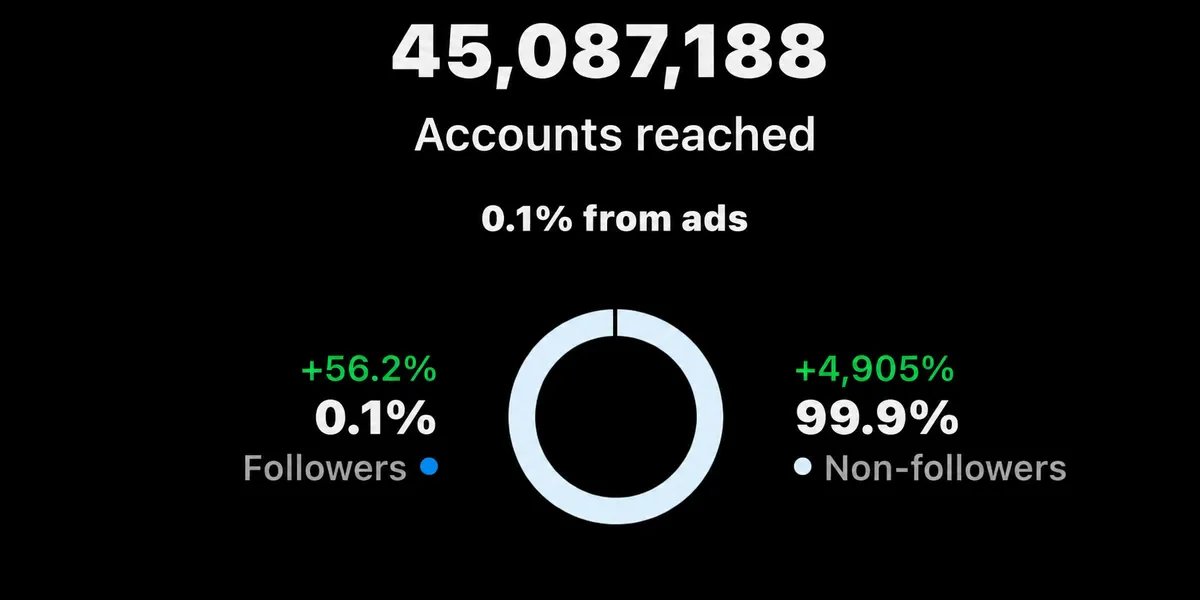
Two numbers matter for this question. First, Instagram itself says 0.1% of that reach came from ads. The other 99.9% the platform handed out for free because people watched. Second, 99.9% of the accounts reached did not follow the page. Organic reach on Reels is not "showing posts to your followers". It is the platform testing your video on strangers and pushing it further when they stay.
That second point is why the old argument for paid, that organic only reaches your followers, does not hold for short video.
Do you need a big following before organic works?
No, and our own dataset shows it. We track 240 Reels and TikToks that beat their own account's usual views, 120 from each platform, across eight industries, collected in September and October 2026. Split by the size of the account that posted them, the small accounts reached about as many people as the big ones.
The 63 videos from accounts under 10,000 followers had median views of 1.3 million, and 46 of them passed a million. The 104 videos from accounts over 100,000 followers had a median of 1.5 million. One caution: this is a list of winners, so it says what is possible on a small account, not what a typical post gets. It does show that follower count does not cap organic reach on short video, which is exactly the thing ads are often sold to fix.
When is paid worth it?
Paid earns its money in four situations:
- A video already won. It beat your account's normal views by a wide margin. Boosting it shows proven work to more of the right people.
- There is a deadline. A grand opening, a listing open house, a holiday sale. Organic cannot promise reach by Saturday.
- The buyer is narrow. If only one postal code or one profession can buy from you, paying to reach exactly them beats hoping the algorithm finds them.
- You are retargeting. Showing an offer to people who already watched your videos or visited your site is something only paid can do.
If none of the four applies, put the money into making more and better videos first.
Can every organic video be boosted later?
No, and this is where hiring one agency for organic and another for paid can go wrong. Instagram's own help page on boosting a Reel (read November 17, 2026) sets these rules:
| Instagram's boost rule | What it means for a business |
|---|---|
| 90 seconds or less, full-screen 9:16 vertical | Long talking videos and horizontal clips cannot be boosted as they are |
| No licensed music; royalty-free from Meta's Sound Collection or original audio instead | A Reel built on a trending song is locked out of boosting |
| No face or camera effects, GIFs, product tags, interactive stickers or third-party filters | Edits made inside the app for organic reach can block the ad |
| Reels already shared to Facebook cannot be boosted | Auto-sharing every Reel to Facebook closes the boost button on them |
| Reels published before October 15, 2021 cannot be used | Old winners have to be re-posted |
Length is rarely the problem. Of the 120 videos in our dataset with a known running time, 93 ran 90 seconds or less. Music and auto-sharing are the usual traps. The fix is simple if you plan for it: keep the edit's audio original or royalty-free on anything you might pay to push, and decide before posting whether a Reel goes to Facebook too.
In what order should a Toronto business spend?
A plain order that works for most local businesses:
- Months one to three: organic only. Post three to four short videos a week (why that number). Judge each one against your account's own median, not against a celebrity's numbers.
- Find the winners. Any video at several times your median is a candidate. Note what its first line said.
- Boost the winners, small. A short boost on a proven video tells you whether paid reach behaves like organic reach for your business.
- Make more of what won. The winners are your brief for the next shoot.
- Scale paid only on proof. Raise a budget when a boosted video brings in calls, bookings or sales you can count.
What should you ask an agency about organic and paid?
Four questions sort agencies quickly:
- Of the results you are showing me, how much came from ads? If they cannot split it, the result tells you less than it seems.
- Who decides what each video says, and how do you judge whether it worked?
- If you run my ads, are the videos made so they can be boosted (music, length, no locked effects)?
- Is the ad budget inside your fee or on top of it? Our post on what a social media marketing agency costs in Toronto covers the market ranges.
If organic short video is the part you want done properly, that is the whole of what we do as a social media marketing agency in Toronto. If you also want ads managed, the comparison page shows which Toronto agencies list them.
Frequently asked questions
Is organic or paid social media better for a small business?
Organic is the better start for most small businesses, because it costs no media budget and shows you which messages your buyers respond to. Paid becomes worth it once you have videos that already beat your account's usual views, or when you need reach by a fixed date.
Can you boost a Reel that uses trending music?
Not if the music is licensed. Instagram's help page on boosting a Reel says boosted Reels cannot use licensed music and recommends royalty-free audio from Meta's Sound Collection or original audio instead. Plan the audio before posting if you might pay to push the video later.
Does organic reach still work on Instagram in 2026?
On Reels, yes. In one client month we run, Instagram counted 45,087,188 accounts reached, 99.9% of them non-followers and 0.1% from ads.
Do social media agencies in Toronto run ads?
Most do. Seven of the ten other agencies on our comparison of Toronto social media marketing agencies list paid social advertising on their websites, read November 6, 2026. Viterno Group does not run paid media; every result we publish is organic.
How much should a business spend on paid social?
There is no single right number, and spending more on a video that has not proven itself mostly buys more of a weak result. Start small on a video that already won organically, and raise the budget only when you can count calls, bookings or sales from it.